


















Every year on 25th April, the world observes World Malaria Day but this is not just another health awareness date. It is a reminder that a disease carried by one tiny mosquito still affects millions of people across the world.
For many people, malaria starts like a normal fever chills, sweating, headache, weakness, body pain. But when testing is delayed, it can turn serious. Severe malaria can affect the blood, brain, kidneys, liver, and overall immunity.
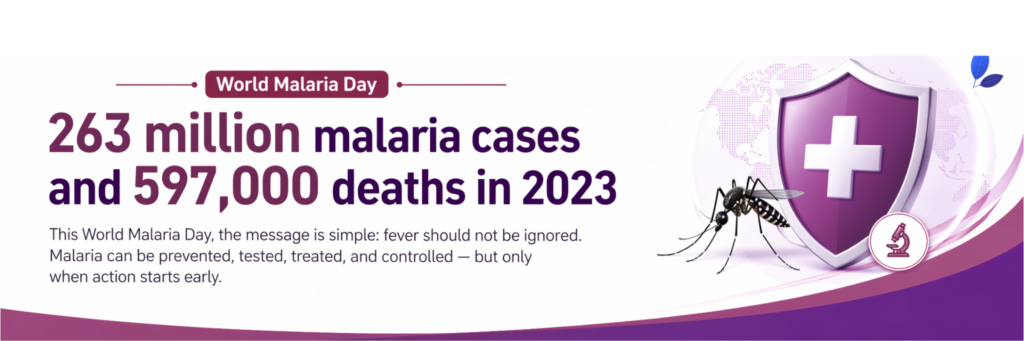
According to the WHO World Malaria Report 2024, the world recorded around 263 million malaria cases and 597,000 deaths in 2023. The African region continues to carry the highest burden, with most cases coming from a few high-risk countries.
Country-Wise Malaria Burden Snapshot
| Country | Share of Global Malaria Cases | Approx. Estimated Cases in 2023 |
|---|---|---|
| Nigeria | 25.9% | Around 68 million cases |
| Democratic Republic of Congo | 12.6% | Around 33 million cases |
| Uganda | 4.8% | Around 12.6 million cases |
| Ethiopia | 3.6% | Around 9.4 million cases |
| Mozambique | 3.5% | Around 9.2 million cases |
| Tanzania | 3.3% | Around 8.6 million cases |
| India | Reported national cases | 2,27,564 cases in 2023 |
These figures show one clear reality malaria is not a small disease. Nigeria and the Democratic Republic of Congo alone contribute a major share of the world’s malaria cases. WHO’s regional data also shows that Nigeria, DRC, Uganda, Ethiopia, and Mozambique together accounted for just over half of malaria cases in the African region in 2023.
India’s story is different and encouraging. India reduced reported malaria cases from 11,69,261 in 2015 to 2,27,564 in 2023, while malaria-related deaths reduced from 384 to 83 during the same period. India also exited the WHO’s High Burden to High Impact group in 2024, showing strong progress in malaria control.
How Can People Stay Safe?
| Safety Step | Why It Helps |
|---|---|
| Use mosquito nets and repellents | Prevents bites, especially during night and early morning |
| Avoid stagnant water | Stops mosquito breeding around homes and buildings |
| Do not ignore fever with chills | Early testing can prevent severe malaria |
| Avoid self-medication | Fever tablets may hide symptoms but not treat malaria |
| Complete the full treatment course | Prevents relapse and future complications |
| Seek hospital care if symptoms worsen | Severe malaria may need ICU or specialist support |
Many international patients from malaria-affected countries travel to India for treatment of fever-related complications, infectious diseases, kidney issues, anaemia, ICU care, and advanced diagnostics. There is no reliable public number showing exactly how many malaria patients come to India every year, but India remains a trusted medical destination because of its strong hospitals, experienced doctors, fast testing, and affordable treatment options.
At Medserg, we help international patients connect with trusted hospitals and specialist doctors in India. From diagnosis and appointments to hospital coordination, travel support, treatment planning, and follow-up care, Medserg supports patients at every step.
This World Malaria Day, the message is simple: fever should not be ignored. Malaria can be prevented, tested, treated, and controlled but only when action starts early.